Achieving high-quality provision in the baby room of English nurseries is a three-part project that aims to open up the conversation around high-quality provision for children 0-2 years old in England. The third and final strand of the baby room project was a series of vision building workshops. These workshops were a space for utopian thinking, imagining what provision can be in an ideal world. We held 5 vision-building workshops between November 2025 and February 2026 with a total of 113 participants.
In this series of blog posts, we will be exploring each section of the vision-building workshops to share what participants want their baby rooms to look and feel like. We started with an ideal baby room (read all about it here), and in this blog post, we will envision how the baby room is situated within the context of the nursery.
The baby room in the context of the nursery
We continued the process of vision-building by thinking about how the baby room is situated within the wider nursery. In our main report (linked here), baby room educators described feeling isolated in their work. This was in the physical sense, with several teams describing how their baby room is perched at the top of the stairs, away from other classrooms. It was also described in the sense of relational distance between themselves and toddler and preschool educators. One participant shared, ‘I think the other staff are quite aware. They say “You’re down there on your own and we don’t get to see you.” You don’t have time to think about the other staff because you’re so busy doing your job that I don’t have time to think, “Oh, I miss it.’’’
It became clear that ‘opening the baby room door’ was a topic that needed to be explored in greater depth for vision-building. The workshops were a space to push well past current realities and understand how baby room educators and nursery managers ideally want baby rooms to fit into wider nursery provision.
The baby room’s location
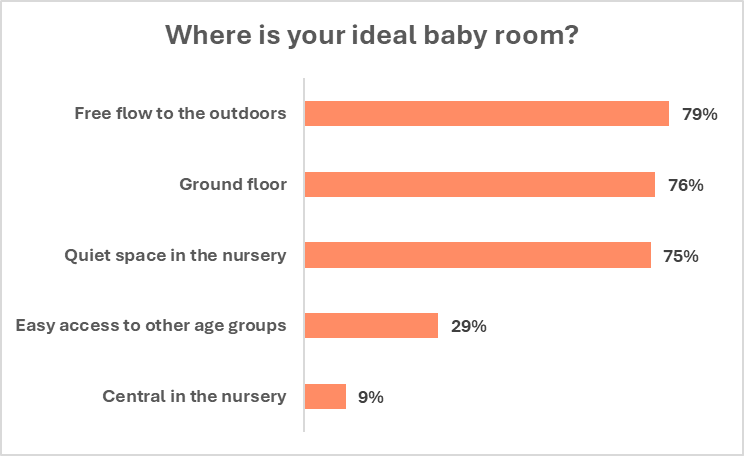
We started off this section by asking where the baby room would ideally be located. The majority of participants wanted a baby room with free flow access to the outdoors (N=87), allowing babies to access the joys of nature without the barrier of formally transitioning them outdoors. This was closely followed by being on the ground floor and in a quiet space in the nursery. From our conferences, it became clear that many baby rooms are positioned on the top floor of the nursery in England. While this may offer a quieter space, it works against the priorities of being on the ground floor, and in settings without a balcony, free flow access to the outdoors. This tells us that many baby rooms across England have an opportunity to reflect more on where they are positioned, and the benefits and drawbacks of their choice.
Mixing age groups across the nursery
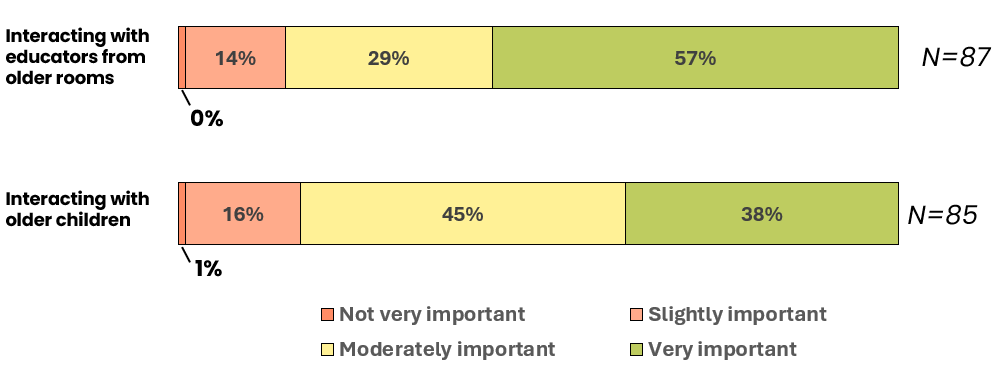
The overwhelming majority of participants felt it was moderately or very important for babies to mix with toddlers and preschoolers in nursery. The same was true for educators: baby room teams felt it was moderately or very important for toddler and preschool educators to engage with babies.
This came to life during our discussion where baby room teams described what this mixing looks and feels like in their ideal world:
‘[Colleagues] coming down, spending time with the staff and the babies, and generally taking interest in what’s happening within the room.’
‘Learning from their peers is quite important- the watching, the seeing how things are done, scaffolding learning and having peers helping them naturally. Particularly the preschool children use a gentler approach with the babies and they’ll coo over them or they’ll try and help them do things. I think it’s nice and healthy for them to be able to have that relationship.’
It became clear that an ideal baby room is one with an open door- that invites in colleagues and older children from across the nursery. They are describing a space where learning and relationships are not confined to one age group; instead the boundaries of the baby room become fluid, bundling up children of all ages and educators from across rooms into its folds. This encourages powerful interactions where children can learn side by side, babies can be scaffolded by older children, and older children can practice being gentle and attentive with the babies. Some participants noted that this is not a ‘one size fits all’ approach, as some children may find the baby room overwhelming or struggle to engage gently with the babies.
As it stands, some baby room teams reported that they mix with older children during certain times of the day, such as meal times, or when they play outside. However, there was a desire for more, to remove the boundaries that only make it feasible to mix once or twice a day. Some went so far as to wonder about how family groupings (a system where a nursery room would have a few babies, a few toddlers, and a few preschoolers) would feel in an ideal world as opposed to having separate baby rooms.
Moving forward
The workshops revealed that, across the sector, baby room teams envision the ideal baby room as having an open door, welcoming a flow of older children and other educators into the practice that happens there. This is balanced with the desire for the baby room to be in a quiet space in the nursery with free flow access to the outdoors. This vision empowers baby room teams to consider the current reality which, for many, is far from this, and ask how we can move ourselves closer to the ideal baby room.
You can read more about the vision building workshops in our Baby Room Vision-Building Online Workshop briefing, linked here: https://thebabyroom.blog/baby-room-vision-building-online-workshop-briefing/. Stay tuned for our final blog post in this series, which will explore how participants envision the ideal baby room team.
 www.thebabyroom.blog
Leave a comment