
Achieving high-quality provision in the baby room of English nurseries is a three part project that aims to open the conversation around high-quality provision for children aged 0-2 years old in England. The first strand of the project was a global evidence review where we learned how quality is defined, measured, and supported for under twos across international literature (linked here: https://thebabyroom.blog/report-1/). The second strand was an exploration of how quality, professional learning, and professionalism are experienced on the ground in English baby rooms (linked here: https://thebabyroom.blog/report-2/).
The third and final strand was a series of vision building workshops (linked here: https://thebabyroom.blog/baby-room-vision-building-online-workshop-briefing/). We designed these workshops as a space to explore how the sector ideally wants quality provision for babies to look and feel, beyond the constraints baby room teams currently face. We held 5 vision-building workshops between November 2025 and February 2026 with a total of 113 participants. We discussed three topics: an ideal baby room; the baby room in the context of the nursery; and the baby room team.
In this mini-series of blog posts, we take a deep-dive into our findings from each section of the workshops. This blog post will explore an ideal baby room, and subsequent posts will focus on the baby room in the context of the nursery, and the baby room team.
An ideal baby room
We started off vision-building by focusing on what an ideal baby room looks and feels like. In our previous discussions with baby room educators and nursery managers, we saw that baby room teams believed quality provision for under twos consists of attuned, close, and consistent relationships with babies and families as well as calm, stimulating environments. The vision-building workshops were a space to push these ideas of the ideal baby room further, and to unpack what that could feel like without the constraints we currently face, such as time and financial constraints.
Number of babies in our ideal baby room
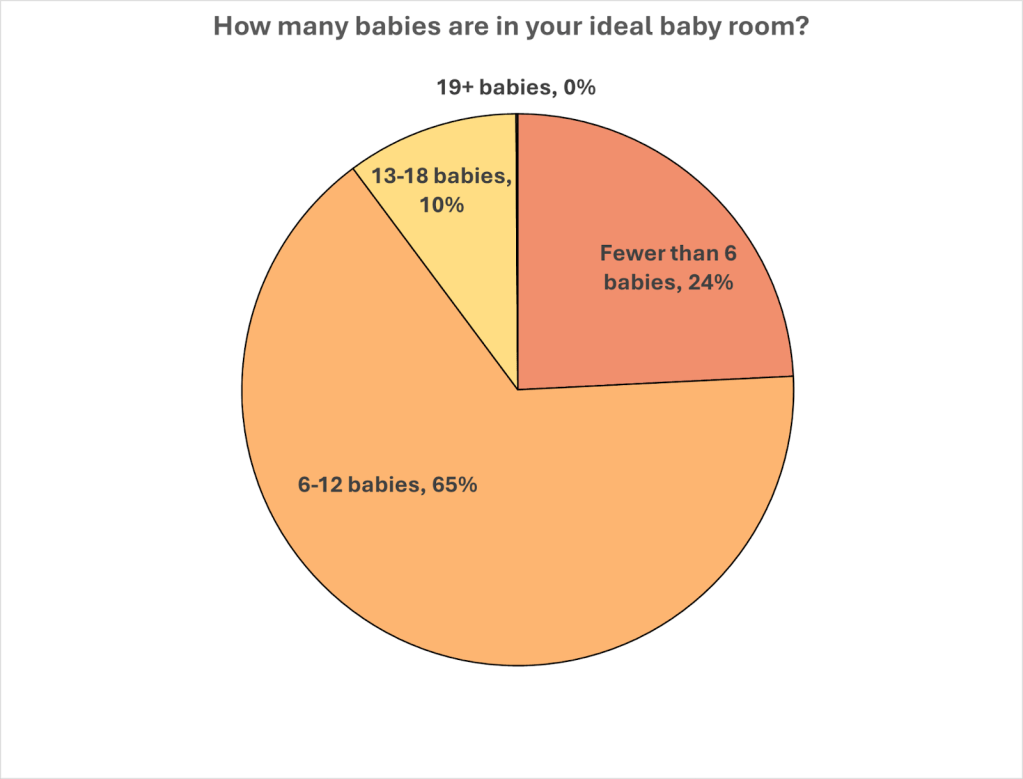
From our conferences, it became clear that baby room educators struggle when they have a large baby room. 65% of participants from the vision-building workshops envisioned between 6 and 12 babies in their ideal baby room (N=78). This tells us that baby room educators want their baby rooms to have a bit of ‘buzz’ (since the majority did not choose to reduce size even further), whilst still remaining calm, manageable spaces for attuned interactions and connection.
Atmosphere of our ideal baby room
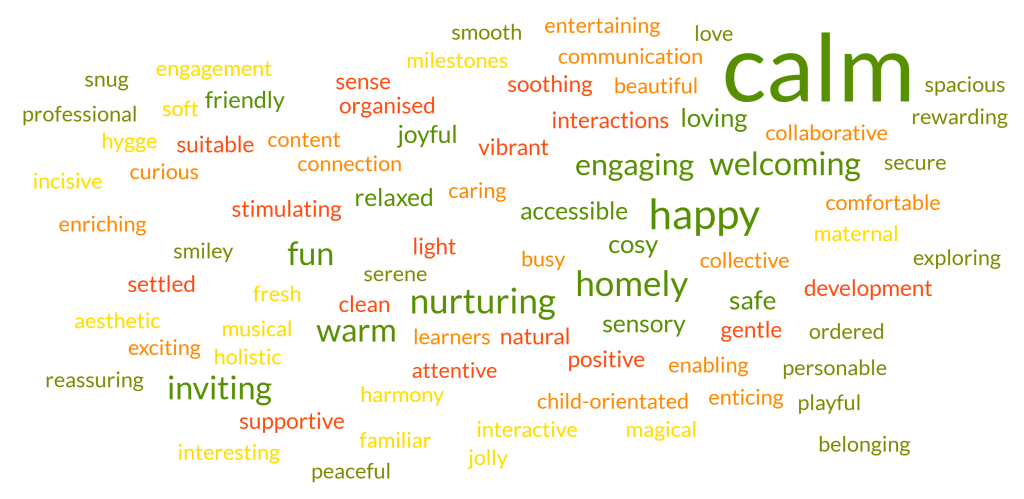
Across our vision-building workshops, participants (N=84) shared that they wanted their baby rooms to feel calm, happy, and homely. The word cloud shows the prevalence of the word ‘calm’ in participants’ responses. This vision helps us connect to what we are striving to offer the babies in our care. Because baby rooms are dynamic spaces, and some days can be challenging, it is important to keep coming back to what we are striving for. This helps us reflect and take small steps towards the ideal of a calm baby room.
Ways to involve families in our ideal baby room
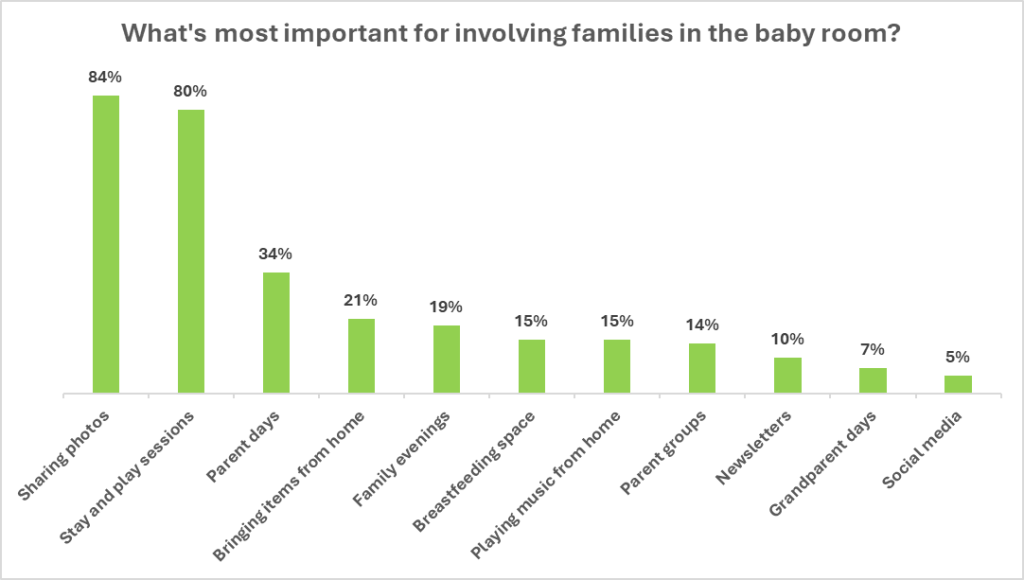
Baby room teams felt that sharing photos and holding stay and play sessions were the best ways to involve families in the baby rooms (N=86). When we asked them to tell us more about this vision, participants shared the following:
‘[Families] feel comfortable, the atmosphere is welcoming for them to be able to stay for a little while, play and engage with the children and just be part of the setting.’
‘I heard some mums talking about the stress of going back to work after maternity leave. It would be great to have a space to support this and to help build trust for new parents.’
In an ideal baby room, baby room teams are craving more time to connect with families and children. They are describing an open door approach to the baby room where families have time to slow down, engage in a chat, and even pop in to be with babies. Baby room teams described how powerful it could be to facilitate connections between families, helping them to derive support from each other during this transition in their lives. As it stands, baby room teams and families are often pressed for time. Slowing down clearly matters greatly, and nurseries and government need to think collaboratively about what can be done to support baby room educators and parents/carers to slow down in a meaningful way. Nurseries might take little steps towards this (e.g. thinking about how movement in and out of the baby room works) but policy also plays a significant role in achieving this (e.g. through structural levers like group size).
Overall, the baby room educators and nursery managers in our workshops envision their ideal baby room as a calm and connected space that embraces babies and families across England. You can read more about the vision building workshops in our Baby Room Vision-Building Online Workshop briefing, linked here: https://thebabyroom.blog/baby-room-vision-building-online-workshop-briefing/.
Stay tuned for our next blog post that unpacks how the sector envisions the baby room in the context of the nursery.
 www.thebabyroom.blog
Leave a comment