
On Saturday June 28th, we welcomed baby room educators and nursery managers from across Cornwall to our fifth ‘Getting it right in the baby room’ conference. We had two incredible speakers with us: Dr Gemma Goldenberg, who discussed the neuroscience of babies brains and how this can shape pedagogy, and Cassie Holland, who discussed the rhythm of the day in the baby room and how to slow down in our practice with babies. Both speakers emphasised how each baby has their own unique rhythm, and that babies engage with the world differently than older children and adults, requiring more time and calmer environments to process information. Our delegates synthesised these messages as a) slowing down their practice and b) fostering a calm environment in the baby room.
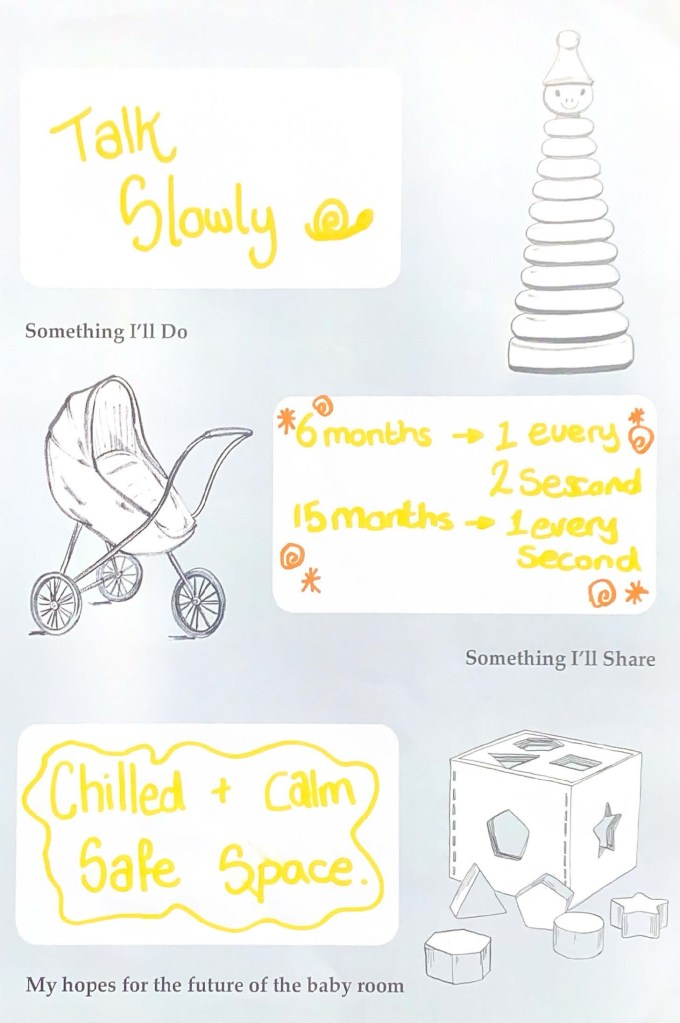
Throughout the day, the delegates critically reflected on the conditions needed for quality to flourish in the baby room and how professional learning can better support their work:
- Baby room educators expressed the importance of team culture and leadership. The leadership of a setting sets the tone for everything from pedagogy to parent-educator relationships, holding the potential to make or break a baby room. A strong team culture in a baby room can lead to strong interpersonal relationships that support retention- on the other hand, a weak team culture can lead skilled educators to leave for other settings, or leave the sector altogether.
- This tied closely to discussions about the effects of the recruitment and retention crisis on baby rooms. Our delegates reflected on how low retention rates are felt intensely in baby rooms with large group sizes, creating challenging experiences for both babies and baby room educators. It’s important to reach out to settings that are struggling with staffing and group size to understand why they are facing difficulties, identify where more needs to be done for babies and families, and pinpoint how we can offer meaningful interventions.
- Baby room educators described how current qualifications and CPD do not work for the baby room. They described how there is a persistent disconnect between theory and practice, that qualifications do not have enough of a focus on babies, and that there is minimal CPD focused on the baby room. Delegates unanimously agreed that mandatory placement in baby rooms should be foundational to qualifications.
- Delegates shared that individuals who are parents or have previous early years experience are often placed in the baby room without support under the assumption that they can ‘figure out’ the technicalities of being with babies. This relies on the false notion that working with young children is down to mothering instinct as opposed to carefully honed skills and dedication to critical, reflective practice.
Our ‘Getting it right in the baby room’ conferences are quickly winding to a close. Next week, we’ll be heading to our final conference in Bristol- keep an eye on our blog for a recap of the day!
Over to you!
What are your thoughts on our key takeaways so far?
Do they resonate with you, or do you have a different experience?


Leave a Reply