
I’m excited to share that we’re at the halfway point of the ‘Getting it right in the baby room’ conferences! On Saturday May 10th, we welcomed baby room educators and nursery managers from across the east of England to Mercure Norwich Hotel. We were blown away by the passion and expertise of this group.
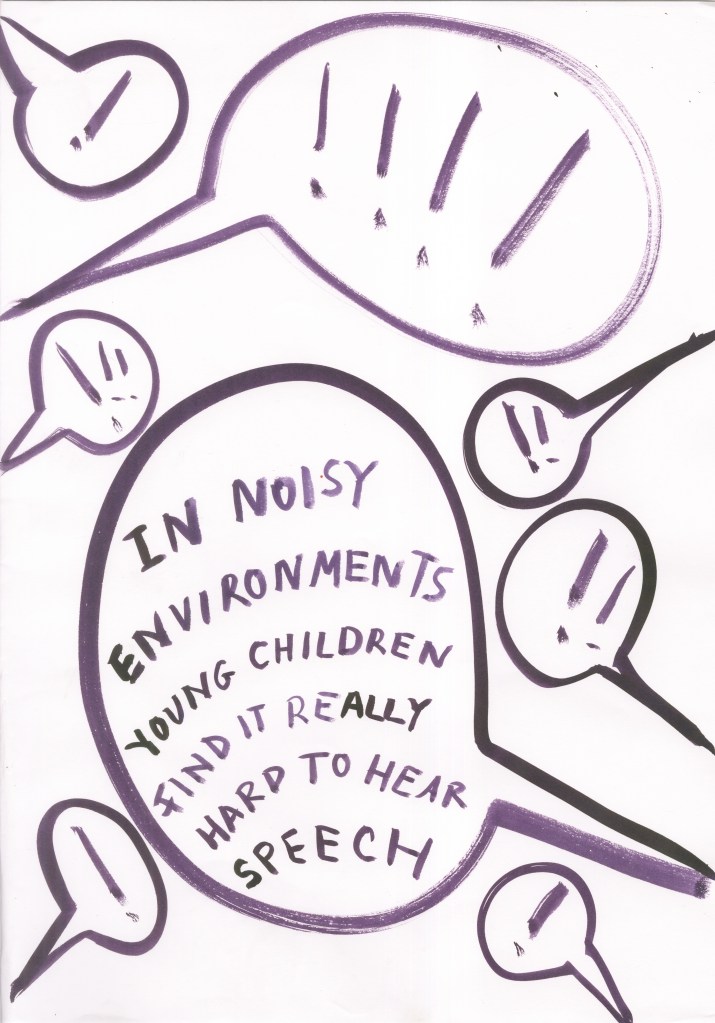
During this conference, our team was particularly struck by how often the conversation turned toward the topic of noise, the environment and quality in the baby room. Dr Gemma Goldenberg shared the importance of a quiet, calm environment when working with babies. Because babies experience external stimuli differently to adults, they are more sensitive to busy, loud environments. Cassie described the importance of slowing down in our practice with babies to make the most of every moment. These conversations resonated with many attendees and generated a lot of thinking about how large group sizes may not be conducive to quiet, slow paced baby rooms, bringing us back to one of our key recommendations around limiting group size in the baby room (see our global evidence review: Report 1 – www.thebabyroom.blog).
Check out Louise Weir’s (our project artist) representation of this below:
In the rest of this post, we’ll share more of the big ideas surfacing from the conference:
- This group of knowledgeable and dedicated baby room educators and nursery managers had a strong desire for continuous professional learning. They really wanted to access professional learning without feeling as though they were in competition with other settings (see this article to learn more about how we can work towards supporting each other in the midst of a competitive EY sector: Leadership Development – Support Collaboration | Parenta.com). Many educators were also longing for the pre-pandemic quality of support from local authorities and Ofsted where people would pop in to offer ideas, conversations and support on a regular basis.
- Building off this, our delegates had the unfulfilled professional desire to connect with other professionals. Isolation is a recurring theme when it comes to the baby room, something that hasn’t changed a lot since Goouch and Powell’s (2013) Baby Room Project over ten years ago. But being connected with other professionals isn’t just about professionalism – it is also about feeling seen. Many baby room educators felt unseen and left behind by Ofsted inspectors, describing how they would only stay in the baby room for a few minutes before moving on to preschool during inspections.
- Resonating strongly with the above, our delegates felt isolated from external agencies such as health visitors and social workers. They felt undervalued and like they are not seen as fellow professionals. This is characterised by disjointed, infrequent, and insufficient communication – which has a knock on effect to the support baby room educators can offer babies and families.
Norwich gave us so much to think about across the board when it comes to quality. We are looking forward to keeping the conversation going at our next conference in Manchester on June 14 – see you soon!
Over to you!
What are your thoughts on our key takeaways so far?
Do they resonate with you, or do you have a different experience?
References
Goouch, K. and Powell, S. (2013) The baby room : principles, policy and practice. Maidenhead: Open University Press, McGraw-Hill Education.
 www.thebabyroom.blog
Leave a comment