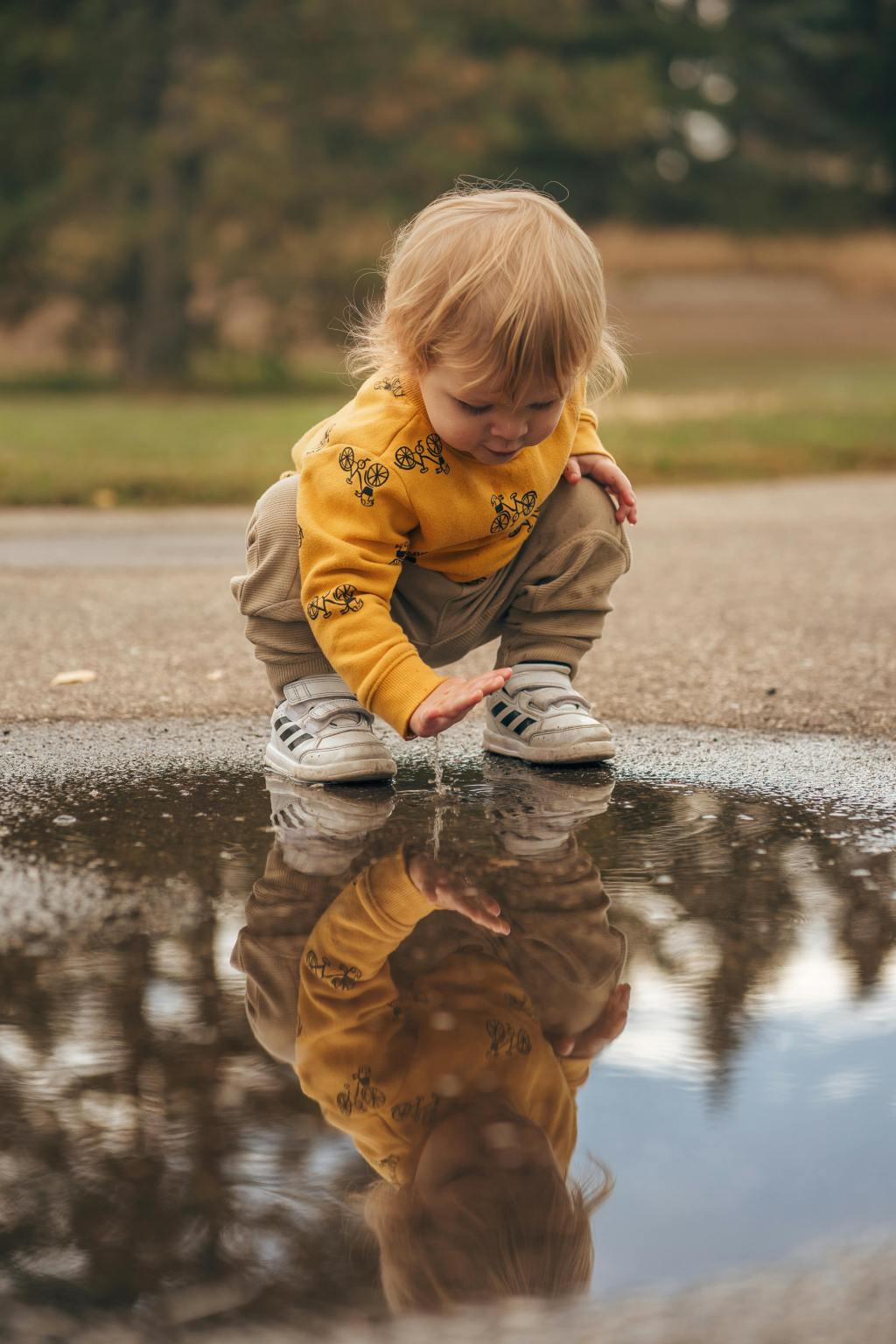
Our research project looks at how to advance quality in baby rooms in England. For this grant, we decided to use the term ‘baby’ to talk about 0-2 year olds. We did this because English nurseries often have a ‘baby room’ that caters to this age group.
We have kicked off our research journey by reading literature from all over the world about ‘babies’, and we’ve found that researchers in most parts of the world don’t use the term ‘baby’ at all. In Australia, we find a similar terminology and separation of 0-2 year olds. However, when we look at the US and most parts of Europe, the common terms are ‘infant’ for 0-1 year olds, and ‘toddlers’ for 1-3 year olds.
A lot of literature we’ve engaged with looks at children that are 1-3 years old, but this of course actually straddles our age group of interest (0-2 year olds). Some of the children in these studies will be in the 1-2 year old range, but many of them will be older than this; it also completely excludes children under the age of 1 year old.
This disconnect prompts us to reflect and ask bigger questions about the words we use and the categories we create for young children. We really want to know: What is a baby?
If we consider the Cambridge Dictionary, a baby is ‘a very young child, especially one that has not yet begun to walk or talk.’ This definition is quite broad and leaves the word ‘young’ up to the reader’s interpretation. What counts as a ‘young’ child will vary between people and countries, as we’ve already started to see in our desktop review. This makes the second part of the definition the most intriguing bit- Is being a baby really as simple as not walking or talking? As soon as you take your first step and utter your first word, are you no longer a baby?
Well, maybe. But we’ve cared for children who have formed complete sentences by 12 months old. We’ve had children take their first step at 9 months. We’ve also worked with children who didn’t start walking until 15 months even though they had spoken their first word long before. Based on this definition, which of these children are considered a baby?
We could also think about feeding practices- is a baby only a baby if they are bottle feeding or breastfeeding? When they are introduced to solid food, are they no longer a baby? Or perhaps when they start feeding themselves- is that the marker?
Thinking wider than development, to be ‘babied’ is often seen as derogatory, implying that a person is being fussed over or even coddled. Well, then is a baby someone who needs an adult to care for them and protect them? Is a baby someone who is incapable of meeting their own needs?
This view ignores babies’ inherent capability and their lightning-fast pace of learning and development. Moreover, while babies do need to be cared for and protected, they are also agentic and capable of making their carers feel loved and important (Halls & Sakr, 2024).
Speaking of love, a baby could be understood in terms of warmth and attachment- babies are often seen as needing consistent, sensitive, and warm affection from adults. But is it really accurate to cite the amount of warmth and affection needed as an indicator of babyhood? Does that need ever really go away, or does it just shift as we age?
These aren’t just questions of semantics – in this project, we want to come up with a sector-led vision for quality in the baby room. So, the first set of questions to ask is about who belongs in this room and why.
Over to you!
- What age range do you think belongs in the baby room and why?
- What words do you use when you talk about children aged 0-2 years old?
References
Cambridge Dictionary (n.d.) Baby. In Cambridge Dictionary Online. Retrieved on 15 October 2024 from https://dictionary.cambridge.org/dictionary/english/baby
Halls, K., & Sakr, M. (2024). Constructions of babyhood among baby room leaders in the UK. Journal of Early Childhood Research. https://doi.org/10.1177/1476718X241279348
 www.thebabyroom.blog
Leave a comment